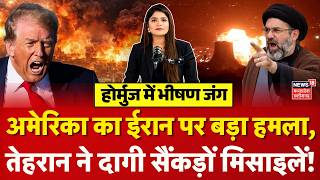
 Reference video
A video on the same topic from an external channel, separate from the reports analyzed here.
US and Iran Exchange Military Strikes in Persian Gulf
Military escalation threatens energy prices and shipping.
Event Overview
The U.S. and Iran have engaged in reciprocal military strikes following a drone attack on a cargo ship in the Strait of Hormuz. U.S. Central Command targeted Iranian missile, drone, and radar sites, while the IRGC targeted U.S. military deployment sites. These actions occur despite a recent memorandum of understanding and interim ceasefire agreement. The conflict has led to travel restrictions on the Iranian World Cup team and efforts to secure alternate shipping routes along the Omani coast.
Issue Summary
Bias Distribution
Bias Signal Summary
40 articles — 8 signal types detected.
Coverage Tone Distribution
· -Redder = higher bias. Larger area = more outlets. Click an outlet to jump to its position.
AI Analysis
All 48 articles focus on military strikes and the failure of the ceasefire agreement, showing a pattern of prioritizing immediate tactical conflict over long-term diplomatic frameworks, which characterizes the coverage as event-driven. Only 1 outlet focuses on the World Cup match as a geopolitical liability for the administration, creating a pattern where sports logistics are linked to foreign policy, describing a niche intersection of cultural and political tension. No articles address the humanitarian impact on civilian populations or the specific economic consequences for local shipping crews, revealing a pattern of omitting non-state actors, which constitutes a substantial missing perspective regarding the human cost of the strikes.
Related Coverage
Coverage flow
Coverage volume
Focus shift
Story timeline
Recommended Reads
Trump says U.S. and Iran will meet in Doha amid weekend strikes near Strait of Hormuz
CBS News
Iran and US trade attacks as Strait of Hormuz ceasefire falters - Al Jazeera
Al Jazeera
US and Iran exchange strikes and accuse each other of violating ceasefire
BBC
The World Cup game the White House cares most about today
Politico
Of the 22 outlets analyzed, 11 focused on Iran as the aggressor and the resulting danger to the US, while 8 highlighted regional instability caused by failed diplomacy and mutual retaliation, and 3 emphasized the broader geopolitical and economic liabilities.
The writer intends to portray the U.S.-Iran relationship as highly volatile and fragile, suggesting that even with an interim deal, the risk of escalation remains high due to conflicting interpretations of sovereignty and ceasefire terms.
The writer intends to portray Iran as the primary aggressor and destabilizing force in the region, framing the current violence as a direct result of Iran's failure to adhere to a ceasefire agreement.
The writer intends to convey that the U.S. is in a precarious strategic position where Iran holds the initiative, intending to instill a sense of imminent danger and the inevitability of further conflict.
The writer intends to present the announcement of diplomatic talks as a developing situation while immediately tempering the certainty of the event by noting the lack of confirmation from the other party.
The writer intends to frame the current U.S.-Iran volatility not as a failure of diplomacy, but as a predictable and manageable 'new normal' where conflict and negotiation coexist.
The writer intends to portray Iran as obstructive and incapable, framing their insistence on sole control of the Strait of Hormuz as a delusional or strategic bluff given their lack of technical capacity.
The writer intends to temper reader expectations regarding price relief, instilling a sense of resignation that economic recovery lags behind diplomatic resolutions due to market mechanics and geopolitical friction.
The writer intends to frame the World Cup match not as a sporting event, but as a geopolitical liability for the Trump administration, highlighting the irony and tension of hosting a nation with which the U.S. is effectively at war.
The writer (system message) intends to inform the user that their access to the website is restricted due to a technical or security block.
The writer intends to present Sen. Marshall's optimistic framing of the conflict and domestic policy as a contrast to the actual events of retaliatory strikes and legislative stalemates, prompting the reader to question the accuracy of Marshall's 'mop-up' and 'negotiation' descriptions.
Loading comments...