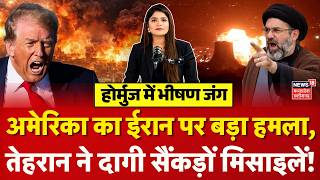
 Reference video
A video on the same topic from an external channel, separate from the reports analyzed here.
US and Iran Exchange Military Strikes in Persian Gulf
Military escalation threatens energy prices and shipping.
Event Overview
The U.S. and Iran have engaged in reciprocal military strikes following a drone attack on a cargo ship in the Strait of Hormuz. U.S. Central Command targeted Iranian missile, drone, and radar sites, while the IRGC targeted U.S. military deployment sites. These actions occur despite a recent memorandum of understanding and interim ceasefire agreement. The conflict has led to travel restrictions on the Iranian World Cup team and efforts to secure alternate shipping routes along the Omani coast.
Issue Summary
Bias Distribution
Bias Signal Summary
40 articles — 8 signal types detected.
Coverage Tone Distribution
· -Redder = higher bias. Larger area = more outlets. Click an outlet to jump to its position.
AI Analysis
All 48 articles focus on military strikes and the failure of the ceasefire agreement, showing a pattern of prioritizing immediate tactical conflict over long-term diplomatic frameworks, which characterizes the coverage as event-driven. Only 1 outlet focuses on the World Cup match as a geopolitical liability for the administration, creating a pattern where sports logistics are linked to foreign policy, describing a niche intersection of cultural and political tension. No articles address the humanitarian impact on civilian populations or the specific economic consequences for local shipping crews, revealing a pattern of omitting non-state actors, which constitutes a substantial missing perspective regarding the human cost of the strikes.
Related Coverage
Coverage flow
Coverage volume
Focus shift
Story timeline
Recommended Reads
Trump says U.S. and Iran will meet in Doha amid weekend strikes near Strait of Hormuz
CBS News
Iran and US trade attacks as Strait of Hormuz ceasefire falters - Al Jazeera
Al Jazeera
US and Iran exchange strikes and accuse each other of violating ceasefire
BBC
The World Cup game the White House cares most about today
Politico
Of the 22 outlets analyzed, 11 focused on Iran as the aggressor and the resulting danger to the US, while 8 highlighted regional instability caused by failed diplomacy and mutual retaliation, and 3 emphasized the broader geopolitical and economic liabilities.
The writer intends to convey that a fragile diplomatic agreement is collapsing into a cycle of retaliation, instilling a sense of regional instability and the risk of an unintentional larger war in the reader.
The writer intends to present a balanced account of a rapidly escalating conflict, illustrating a cycle of retaliation where both parties view the other as the primary aggressor and treaty-breaker, thereby leaving the reader with a sense of instability and fragility regarding the ceasefire.
The writer intends to convey a sense of escalating military tension and political aggression, positioning the situation as an active conflict with an unpredictable leadership element.
The writer intends to portray Iran as a destabilizing force and a 'treacherous' actor that undermines peace efforts, leading the reader to view the Trump-Pezeshkian diplomacy as a high-risk gamble.
The writer intends to frame the U.S. military action as a justified and proportional reaction to Iranian provocation, adopting the terminology of U.S. Central Command to instill a perception of legitimate deterrence.
The writer intends to convey that the fragile peace between the US and Iran is highly unstable and that the conflict is at risk of escalating despite ongoing diplomatic negotiations.
The writer intends to convey that the agreement to wind down the U.S.-Iran war is being undermined by continued aggression and Iran's desire to assert dominance over the Strait of Hormuz.
The writer intends to present the U.S. military action as a justified and forceful retaliation, adopting the military's own framing of the event to instill a sense of decisive American response in the reader.
The writer intends to convey that the peace process is precarious and highly volatile, suggesting that regional power struggles over strategic waterways and proxy conflicts in Lebanon are more influential than the diplomatic efforts of mediators.
The writer intends to portray the current geopolitical situation as highly volatile and fragile, emphasizing that diplomatic agreements (the MoU and the Israel-Lebanon framework) are being undermined by military aggression and internal rejection.
Loading comments...