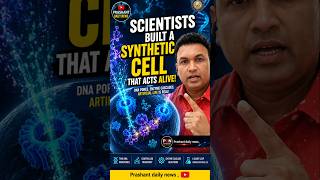
 Reference video
A video on the same topic from an external channel, separate from the reports analyzed here.
University of Minnesota Researchers Create SpudCell
First synthetic cell to complete a full division cycle.
Event Overview
Researchers at the University of Minnesota, led by Kate Adamala, developed 'SpudCell,' a synthetic cell built from non-living chemical components including liposomes, DNA, and 36 commercial enzymes. The cell can grow, replicate its genetic material, and divide, though it requires external ribosomes and nutrients to function. The project has been released in an open-source format and published as a preprint on bioRxiv.
Issue Summary
Bias Distribution
Bias Signal Summary
6 articles — 2 signal types detected.
Coverage Tone Distribution
· -Redder = higher bias. Larger area = more outlets. Click an outlet to jump to its position.
AI Analysis
Missing perspectives include ethical and regulatory critiques regarding the creation of synthetic life, as well as independent scientific peer review of the preprint's findings.
Related Coverage
Coverage flow
Coverage volume
Focus shift
Story timeline
Recommended Reads
Scientists create first synthetic cell that can complete life cycle
CBS News
For The First Time, Scientists Say They've Built a Synthetic Cell From Scratch - ScienceAlert
sciencealert.com
'Milestone': Scientists claim to build synthetic cell, raising concerns in step toward artificial life - Fox News
Fox News
‘Beautiful blobs’: synthetic life a step closer as scientists make cells using lab-made DNA
The Guardian
Coverage was evenly split among the four outlets, with two focusing on revolutionary innovation and progress, while the other two adopted a more cautious tone by balancing milestones with biosafety risks.
The writer intends to present the creation of SpudCell as a groundbreaking proof-of-concept that demystifies the 'spark' of life, encouraging the reader to view synthetic biology as a viable path toward precision bio-engineering.
The writer intends to present a scientific breakthrough as a 'milestone' while simultaneously tempering the excitement with warnings about its current limitations and potential future biosafety risks.
The writer intends to present the creation of SpudCells as a significant scientific milestone that brings humanity closer to engineering life, while balancing the excitement with technical limitations and philosophical skepticism to maintain a journalistic tone of objective curiosity.
The writer intends to present this scientific achievement as a historic breakthrough, instilling a sense of wonder and progress regarding the possibility of creating artificial life.
The writer intends to present this scientific breakthrough as a revolutionary milestone that solves a fundamental limitation in biological engineering, instilling a sense of optimism about a future of sustainable, pollutant-free manufacturing.
The writer intends to inform the reader of a significant scientific milestone, instilling a sense of progress and innovation in the field of synthetic biology.
Loading comments...