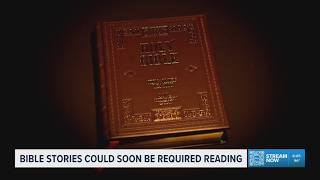
 Reference video
A video on the same topic from an external channel, separate from the reports analyzed here.
Texas State Board of Education Approves Mandatory Bible Reading List
Texas mandates Bible stories for all K-12 public students.
Event Overview
The Republican-controlled Texas State Board of Education voted to approve a mandatory K-12 reading list that includes biblical passages for approximately 5 to 5.5 million public school students. The curriculum will be phased in starting in 2030, beginning with elementary students and progressing through high school. The list pairs biblical texts, such as Exodus and the New Testament, with literary classics by authors like Charles Dickens and William Shakespeare.
Issue Summary
Bias Distribution
Bias Signal Summary
19 articles — 7 signal types detected.
Coverage Tone Distribution
· -Redder = higher bias. Larger area = more outlets. Click an outlet to jump to its position.
AI Analysis
Missing are the perspectives of educators and school administrators regarding the practical implementation of the curriculum, as well as legal analysis concerning the First Amendment's Establishment Clause. There is also a lack of input from students and parents who may view the Bible strictly as a literary or historical text rather than a religious or political tool.
Related Coverage
Coverage flow
Coverage volume
Focus shift
Story timeline
Recommended Reads
Texas mandates Bible readings and Christian-infused curriculum in public schools - Salon.com
salon.com
Texas is poised to require millions of students to study Bible stories - CNN
CNN
Texas Board Of Education Votes To Require Students To Read Bible Passages
Daily Caller
Texas becomes first state to mandate students read the Bible in public school - Houston Chronicle
houstonchronicle.com
While seven of the 12 outlets framed the policy as a polarizing expansion of religious influence, three viewed it as a violation of minority rights and religious indoctrination, and two presented it as an existential necessity for American freedom.
The writer intends to frame the policy as a potentially unconstitutional expansion of Christianity into public education, prompting the reader to view the move as a blurring of the line between secular academic study and religious indoctrination.
The writer intends to present the mandate as part of a broader trend of 'Christian-themed policy' in Texas, framing it as a significant shift in educational authority from teachers to the state.
The writer intends to frame the policy as a controversial expansion of conservative religious influence in public education, highlighting the tension between 'traditional values' and constitutional separations of church and state.
The writer intends to frame the proposal as a controversial and unprecedented expansion of religious influence in public education, prompting the reader to view it as a potential violation of constitutional boundaries and religious inclusivity.
The writer intends to frame the inclusion of the Bible in Texas schools as an existential necessity for the survival of American freedom, urging the reader to view secular education as a catalyst for socialist 'orthodoxy' and moral decay.
The writer intends to present the decision as part of a broader, systematic effort by conservative officials to integrate Christian teachings into the Texas public school system, while providing a balanced view of the ideological conflict between traditionalists and progressives.
The writer intends to present the inclusion of religious texts in a mandatory state curriculum as a significant and polarizing shift in public education, prompting the reader to view it as a departure from standard educational norms.
The writer intends to frame the policy as part of a broader, aggressive conservative effort to Christianize public education, prompting the reader to view the move as a potential violation of constitutional boundaries and parental autonomy.
The writer intends to frame the policy as a contentious ideological move by conservatives to increase Christian influence in public education, highlighting the resulting conflict between religious tradition and civil liberties/educational autonomy.
The writer seeks to present the inclusion of Bible passages in schools as a positive move for critical thinking and cultural literacy, while using a high-profile athlete's endorsement to validate the decision.
Loading comments...