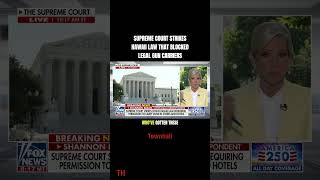
 Reference video
A video on the same topic from an external channel, separate from the reports analyzed here.
US Supreme Court strikes down Hawaii gun laws
The ruling expands Second Amendment rights over state laws.
Event Overview
The US Supreme Court struck down gun restrictions in Hawaii, including a measure referred to as the 'vampire rule.' The decision was based on a legal standard of historical tradition, rejecting analogues such as hunting laws and Black Codes. This ruling follows similar blocks of measures in New York, California, and Maryland.
Issue Summary
Bias Distribution
Bias Signal Summary
21 articles — 6 signal types detected.
Coverage Tone Distribution
· -Redder = higher bias. Larger area = more outlets. Click an outlet to jump to its position.
AI Analysis
Missing are the perspectives of public safety officials and law enforcement regarding the practical impact of the ruling on crime prevention. There is also a lack of input from the Hawaii state government or the legal architects of the challenged measures.
Related Coverage
Coverage flow
Coverage volume
Focus shift
Story timeline
Recommended Reads
Samuel Alito Shreds Hawaii’s ‘Spirit Of Aloha’ Legal Defense In ‘Vampire Rule’ Gun Ruling
Daily Caller
Gun owners may carry a weapon into stores, Supreme Court rules, rejecting a California law - Los Angeles Times
LA Times
Supreme Court rolls back limits on carrying guns on private property open to public
ABC News
Guns, Property Rights, and the Second Amendment
Reason
Of the 17 outlets analyzed, nine supported the ruling as a defense of constitutional rights, while five remained neutral on the expansion of gun rights and ideological divides, and three criticized the Court's jurisprudence as dangerous or ideologically driven.
The writer intends to persuade the reader that the Supreme Court's ruling in Wolford v. Lopez is a victory for constitutional rights and that the current 'history and tradition' legal test is a dangerous tool that should be replaced by a text-and-purpose based approach.
The writer intends to portray the State of Hawaii's legal arguments as absurd, historically repugnant, and legally baseless, framing the Supreme Court's ruling as a necessary defense of fundamental national rights against local attempts to bypass the Constitution.
The writer intends to present the ruling as a significant legal shift that prioritizes Second Amendment rights over state-level public safety regulations, while highlighting the deep ideological divide between the court's majority and gun control advocates.
The writer intends to frame the SCOTUS ruling as a victory for Second Amendment rights and a defeat for state-level attempts to circumvent constitutional protections, instilling a sense of triumph in the reader.
The writer intends to present the ruling as a significant expansion of Second Amendment rights over state-level restrictions, while framing the conflict as a tension between individual gun rights and private property rights.
The writer intends to frame the ruling as part of a broader, ideologically driven trend by the current Supreme Court to expand gun rights through a controversial historical test that confuses lower courts.
The writer intends to frame the ruling as a victory for fundamental constitutional rights over state-level attempts to circumvent judicial precedents, instilling in the reader the perception that Hawaii's law was an illogical and historically baseless restriction on daily life.
The writer intends to frame the ruling as a victory for constitutional consistency over local cultural justifications, portraying the 'spirit of aloha' argument as an insufficient legal basis for restricting fundamental rights.
The writer intends to frame the ruling as a victory for constitutional liberties over government overreach, portraying the state of Hawaii's legal arguments as not only incorrect but morally offensive due to their reference to the Black Codes.
The writer intends to present the ruling as part of a broader judicial trend toward expanding Second Amendment rights, positioning the event as a legal victory for gun-rights advocates and the Trump administration.
Loading comments...