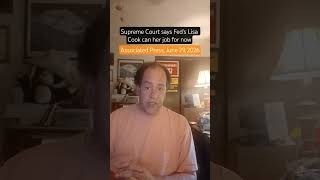
 Reference video
A video on the same topic from an external channel, separate from the reports analyzed here.
Supreme Court Rules on Presidential Removal Power
Court expands president's power to fire agency officials.
Event Overview
The Supreme Court ruled 6-3 in Trump v. Slaughter that the president has the authority to remove members of independent agencies, such as the FTC, at will for policy reasons. This decision overturns the 1935 precedent set in Humphrey's Executor v. U.S., which had required 'for cause' removal protections. While the ruling allows President Trump to fire officials like Rebecca Slaughter, the court ruled in Trump v. Cook that he cannot currently remove Federal Reserve governor Lisa Cook.
Issue Summary
Bias Distribution
Bias Signal Summary
34 articles — 11 signal types detected.
Coverage Tone Distribution
· -Redder = higher bias. Larger area = more outlets. Click an outlet to jump to its position.
AI Analysis
Missing are the perspectives of the affected agency officials and legal scholars focusing on the specific distinction between the FTC and Federal Reserve rulings. There is also a lack of analysis regarding the potential economic impact of removing "for cause" protections from independent regulatory bodies.
Related Coverage
Coverage flow
Coverage volume
Focus shift
Story timeline
Recommended Reads
Supreme Court cements Trump's power over agencies long considered independent
NPR
In Landmark Ruling, Supreme Court Affirms That Presidents Run The Executive Branch
The Federalist
Supreme Court lets presidents fire independent regulators, rules for Trump in FTC case
CNBC
Can the Supreme Court Slaughter Slaughter Without Cooking Cook?
Reason
Coverage of the ruling is split across three distinct perspectives: eight outlets adopted an alarmist tone warning of authoritarianism, six provided an analytical look at expanded executive control, and six framed the decision as a celebratory victory over the administrative state.
The writer intends to portray the Roberts Court's ruling as a betrayal of true originalism that dangerously expands presidential power. The reader is expected to view the decision not as a legal correction, but as the imposition of a modern, stilted understanding of the separation of powers.
The writer intends to frame the Supreme Court's ruling as a dangerous expansion of executive power that threatens the apolitical nature of government agencies, using Weissmann's alarmist language to instill a sense of urgency and fear in the reader.
The writer intends to validate the 'unitary executive' theory as the only constitutionally sound interpretation of Article II, while framing the Court's specific application of this logic in the Cook case as an embarrassing inconsistency.
The writer intends to frame the Supreme Court's ruling as a dangerous empowerment of a president who already uses government agencies for personal and familial financial gain, intending to instill a sense of alarm and urgency in the reader regarding the erosion of democratic checks and balances.
Loading comments...