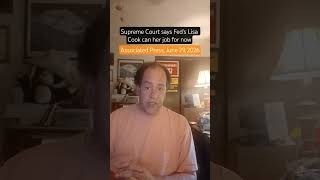
 Reference video
A video on the same topic from an external channel, separate from the reports analyzed here.
Supreme Court Rules on Presidential Removal Power
Court expands president's power to fire agency officials.
Event Overview
The Supreme Court ruled 6-3 in Trump v. Slaughter that the president has the authority to remove members of independent agencies, such as the FTC, at will for policy reasons. This decision overturns the 1935 precedent set in Humphrey's Executor v. U.S., which had required 'for cause' removal protections. While the ruling allows President Trump to fire officials like Rebecca Slaughter, the court ruled in Trump v. Cook that he cannot currently remove Federal Reserve governor Lisa Cook.
Issue Summary
Bias Distribution
Bias Signal Summary
34 articles — 11 signal types detected.
Coverage Tone Distribution
· -Redder = higher bias. Larger area = more outlets. Click an outlet to jump to its position.
AI Analysis
Missing are the perspectives of the affected agency officials and legal scholars focusing on the specific distinction between the FTC and Federal Reserve rulings. There is also a lack of analysis regarding the potential economic impact of removing "for cause" protections from independent regulatory bodies.
Related Coverage
Coverage flow
Coverage volume
Focus shift
Story timeline
Recommended Reads
Supreme Court cements Trump's power over agencies long considered independent
NPR
In Landmark Ruling, Supreme Court Affirms That Presidents Run The Executive Branch
The Federalist
Supreme Court lets presidents fire independent regulators, rules for Trump in FTC case
CNBC
Can the Supreme Court Slaughter Slaughter Without Cooking Cook?
Reason
Coverage of the ruling is split across three distinct perspectives: eight outlets adopted an alarmist tone warning of authoritarianism, six provided an analytical look at expanded executive control, and six framed the decision as a celebratory victory over the administrative state.
The writer intends to notify the reader that significant legal decisions have been made, directing them toward a video or app for the full details.
The writer intends to portray Chief Justice Roberts as inconsistent or overly pragmatic, suggesting that his desire to protect the Federal Reserve has led him to create a constitutional contradiction that undermines his own stated principles of executive accountability.
The writer intends to frame the ruling as a critical but fragile victory for democratic stability, warning the reader that Trump is attempting to weaponize federal agencies and that the Supreme Court's 'unitary executive' crusade poses a systemic threat to the economy.
The writer intends to instill a sense of skepticism regarding the Supreme Court's legal reasoning, suggesting that the distinction between the two rulings is arbitrary or policy-driven rather than based on a consistent constitutional principle.
The writer intends to frame the Slaughter decision as a monumental victory for executive power and a necessary blow to the 'administrative state,' while dismissing other rulings as narrow or easily bypassed, thereby instilling a sense of triumph for Trump's agenda.
The writer intends to instill a sense of alarm and skepticism in the reader, framing the ruling as a dangerous expansion of presidential power that threatens the constitutional separation of powers.
The writer intends to frame the Supreme Court's ruling not as a neutral legal interpretation of the separation of powers, but as the judicial execution of a pre-planned political blueprint (Project 2025) to dismantle agency independence and consolidate executive control.
The writer intends to portray Trump as volatile and reactionary, contrasting his 'seething' responses to legal losses with his celebration of expanded executive power, thereby framing him as a leader focused on personal grievances and the accumulation of authority.
The writer intends to alarm the reader by framing the Supreme Court's ruling as a dangerous dismantling of democratic checks and balances that paves the way for authoritarian executive power.
The writer intends to convey that despite a few visible legal defeats, the Supreme Court has fundamentally strengthened Trump's presidency and the Republican Party's structural power, leaving the reader with a sense of concern over the concentration of executive authority.
Loading comments...