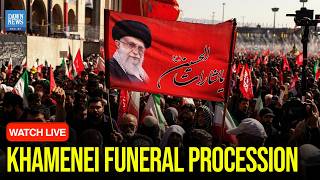
 Reference video
A video on the same topic from an external channel, separate from the reports analyzed here.
Iran Holds Funeral for Supreme Leader Ali Khamenei
Massive mourning and leadership uncertainty follow death.
Event Overview
Millions of people in Iran and Iraq attended funeral services for Supreme Leader Ayatollah Ali Khamenei, who was killed in an airstrike attributed to the U.S. and Israel. While senior officials and three of Khamenei's sons attended the Tehran service, his successor, Mojtaba Khamenei, was notably absent. The events featured slogans against the U.S. and Israel, with the Iranian government utilizing religious symbolism to promote narratives of resistance and unity.
Issue Summary
Bias Distribution
Bias Signal Summary
5 articles — 2 signal types detected.
Coverage Tone Distribution
· -Redder = higher bias. Larger area = more outlets. Click an outlet to jump to its position.
AI Analysis
Missing are the perspectives of the general public attending the funerals, specifically whether their participation was organic or coerced, and the official responses or justifications from the U.S. and Israel regarding the airstrike.
Related Coverage
Coverage flow
Coverage volume
Focus shift
Story timeline
Recommended Reads
Iranians mourn former Supreme Leader
NBC News
What is the religious and political messaging behind Khamenei’s funeral? - Al Jazeera
Al Jazeera
Khamenei's other sons appear at his funeral in Iran as new supreme leader remains in hiding - AP News
AP News
Iran's supreme leader absent as senior officials attend ayatollah's funeral - BBC
BBC
Analysis of the four outlets is split evenly, with two viewing the funeral as a calculated political operation for power and legitimacy, while the other two frame it as a demonstration of national resilience and defiance.
The writer intends to highlight the instability and tension surrounding the Iranian leadership transition by emphasizing Mojtaba Khamenei's absence and the hostile rhetoric between the US and Iran during a period of fragile ceasefire.
The writer intends to highlight a potential tension or uncertainty in the Iranian leadership transition by contrasting the public mourning with the absence of the new Supreme Leader.
The writer intends to show that the funeral is not merely a mourning period but a calculated state operation using religious semiotics to legitimize the new leadership and mobilize regional Shia support for resistance against foreign enemies.
The writer intends to portray the funeral not just as a religious rite, but as a calculated political demonstration of Iranian resilience and defiance amidst a high-stakes conflict with the U.S. and Israel.
The writer intends to convey the scale of public grief and anger in Iran, framing the event as a catalyst for potential retaliation against the U.S. and Israel.
Loading comments...