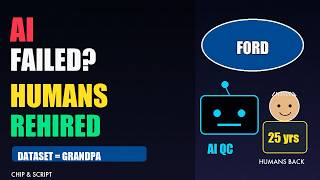
 Reference video
A video on the same topic from an external channel, separate from the reports analyzed here.
Ford Rehires Veteran Engineers to Improve Quality Control
Ford returns to human expertise after AI quality failures.
Event Overview
Ford Motor Company has rehired between 300 and 350 experienced engineers, referred to as 'gray beards,' to address production quality shortcomings. The company had previously prioritized AI and automated design systems, leading to a loss of institutional knowledge and significant financial losses. These veteran engineers now serve as internal auditors, conducting design reviews and retraining AI tools to eliminate failure points before production.
Issue Summary
Bias Distribution
Bias Signal Summary
8 articles — 7 signal types detected.
Coverage Tone Distribution
· -Redder = higher bias. Larger area = more outlets. Click an outlet to jump to its position.
AI Analysis
Missing perspectives include the viewpoint of the AI developers or Ford's technical leadership regarding how these "gray beards" are specifically improving the AI tools, as well as the perspective of the younger workforce being retrained. There is also no analysis of the long-term financial implications or the potential for a hybrid human-AI model to outperform either alone.
Related Coverage
Coverage flow
Coverage volume
Focus shift
Story timeline
Recommended Reads
Ford Hiring 350 Engineers After AI Failed Shows Human Value In AI Era
Forbes
Ford on why it hired 350 'gray beard' engineers: you need their mentorship for younger workers — and to drive huge AI productivity gains - Fortune
fortune.com
Ford Discovers Humans Can’t Be Replaced After All
Daily Caller
Ford rehires experienced engineers after AI misses the mark
NY Post
Three of the four outlets argued that AI is an insufficient replacement for human expertise and has led to failure, while only one suggested that AI will likely eventually surpass human intuition.
The writer intends to convey that human expertise is indispensable and that relying solely on AI for complex industrial processes is a mistake, positioning Ford's return to human-centric engineering as the driver of its recent quality success.
The writer intends to portray the replacement of human expertise with AI as a costly mistake, instilling the perception that human judgment is indispensable and superior to automation in complex industrial quality control.
The writer intends to convey that human expertise is indispensable and that over-reliance on AI in complex industrial processes is a mistake, positioning Ford's return to human-centric quality control as a successful strategic correction.
The writer intends to convey that human expertise remains indispensable and that over-reliance on AI for complex quality control can lead to costly failures.
The writer intends to portray AI as an insufficient replacement for human expertise, suggesting that Ford's attempt to automate quality control was a failure that required a return to traditional human knowledge to rectify.
The writer intends to warn business leaders that replacing human expertise with AI leads to systemic failure, instilling the belief that human experience is an indispensable prerequisite for AI success rather than a cost to be eliminated.
The writer intends to portray AI as an imperfect tool that cannot replace human intuition and experience, while simultaneously warning the reader that this 'victory' for humans is likely temporary and a precursor to total redundancy.
The writer intends to frame Ford's strategy as a successful blueprint for the 'AI era,' suggesting that the key to productivity and quality is not replacing humans with AI, but using experienced human wisdom to augment and audit AI.
Loading comments...