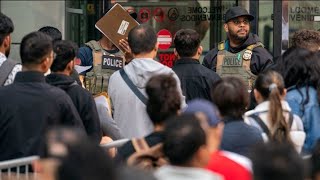
 Reference video
A video on the same topic from an external channel, separate from the reports analyzed here.
Courts Rule on ICE Courthouse Arrests and Speedy Deportations
Federal courts issue conflicting rulings on ICE enforcement.
Event Overview
A federal judge blocked the Trump administration's policy of conducting ICE arrests at immigration courthouses nationwide, citing a lack of reasoned explanation and concerns over court attendance. Simultaneously, a federal appeals court overturned a lower court decision to allow the expansion of fast-track deportations of undocumented migrants across the U.S. This appeals court ruling permits expedited removal for those unable to prove two years of continuous presence. These decisions have sparked debate over judicial activism and the balance between administrative efficiency and due process.
Issue Summary
Bias Distribution
Bias Signal Summary
Coverage Tone Distribution
· -Redder = higher bias. Larger area = more outlets. Click an outlet to jump to its position.
AI Analysis
Missing are the direct perspectives of the undocumented migrants affected by these rulings and the operational viewpoints of ICE agents implementing these policies. There is also a lack of legal analysis from non-partisan constitutional scholars regarding the specific balance of due process versus administrative efficiency.
Related Coverage
Coverage flow
Coverage volume
Focus shift
Story timeline
Recommended Reads
Federal judge bans ICE from arresting people in immigration courts
LA Times
Biden-appointed judge ripped after blocking ICE arrests at immigration courts
Washington Examiner
Judge vacates Trump policy allowing arrests at immigration courts - Politico
Politico
Federal appeals court allows the Trump administration to resume expanded use of speedy deportations - AP News
AP News
Analysis of five outlets reveals a split perspective: two viewed the ruling as a necessary correction to flawed government policy, two attributed it to political polarization and judicial appointments, and one characterized it as partisan judicial activism.
The reader is left with the impression that the court's ruling is a necessary correction to an illogical and fear-inducing government policy, while the government's opposition is portrayed as ideologically driven rhetoric.
The article leaves the reader with the impression that the judicial ruling is a partisan act of 'judicial activism' that obstructs necessary immigration enforcement, while presenting the legal justifications as secondary to the political controversy.
The reader is left with the impression that the Trump administration's courthouse arrest policies were legally unsound and lacked a rational basis, while the administration's opposition to the ruling is portrayed as ideological rhetoric.
The reader is left with the impression of a polarized legal battle where the outcome was influenced by the political leanings of the judges, pitting the administration's goal of mass deportation against the ACLU's concerns over systemic errors and civil rights.
The article leaves the reader with the impression that the ruling is a partisan judicial outcome, emphasizing the political alignment of the judges and the potential erosion of due process for immigrants.
The article leaves the reader with the impression of a polarized legal battle where the outcome is heavily influenced by the political appointment of the judges, contrasting administrative efficiency against individual due process rights.
Loading comments...