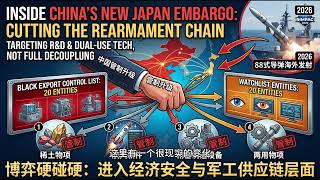
 Reference video
A video on the same topic from an external channel, separate from the reports analyzed here.
China Imposes Export Controls on Japanese Entities
China uses trade restrictions to pressure Japan's military.
Event Overview
China's Commerce Ministry has placed 40 Japanese entities, including defense contractors and civilian firms, on export control and watch lists. These measures restrict the sale of dual-use items, specifically critical minerals and rare earth elements. Beijing justifies these actions as a deterrent against Japan's 'new militarism' and increased defense spending. The move follows tensions regarding Japan's security alignment with the U.S. and potential military deployment in Taiwan.
Issue Summary
Bias Distribution
Bias Signal Summary
4 articles — 2 signal types detected.
Coverage Tone Distribution
· -Redder = higher bias. Larger area = more outlets. Click an outlet to jump to its position.
AI Analysis
Missing are the official perspectives of the Japanese government and the specific Japanese firms affected, as well as analysis from industry experts on the actual economic impact of these mineral restrictions.
Related Coverage
Coverage flow
Coverage volume
Focus shift
Story timeline
Recommended Reads
China Widens Export Curbs on Japan, Claiming 'New Militarism'
Newsweek
China imposes export controls on 40 Japanese entities as tensions with Tokyo rise - AP News
AP News
China has accused Japan of ‘reckless militarism’. What’s behind the latest tensions?
The Guardian
China targets more Japanese companies with export controls - Financial Times
Financial Times
Three outlets provided distinct perspectives: one focused on China's use of export controls as a geopolitical weapon, one analyzed the historical and political complexities of global tensions, and one prioritized commercial subscription acquisition.
The writer intends to frame China's export controls as a strategic weaponization of resources used to pressure Japan and deter its security alignment with the U.S., while presenting China's 'new militarism' claim as a narrative tool.
The writer intends to entice the reader to purchase a subscription to access the full story regarding China's export controls on Japanese companies.
The writer intends to present the export controls not as an isolated trade dispute, but as a symptom of a deteriorating security cycle where Japanese military expansion and Chinese reactions reinforce one another.
The writer intends to present the current tensions as a complex interplay between immediate geopolitical triggers (Taiwan) and deep-seated historical trauma, suggesting that while political rhetoric is volatile, economic interdependence remains a stabilizing force.
Loading comments...