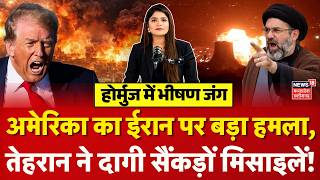
 Reference video
A video on the same topic from an external channel, separate from the reports analyzed here.
US and Iran Exchange Military Strikes in Persian Gulf
Military escalation threatens energy prices and shipping.
Event Overview
The U.S. and Iran have engaged in reciprocal military strikes following a drone attack on a cargo ship in the Strait of Hormuz. U.S. Central Command targeted Iranian missile, drone, and radar sites, while the IRGC targeted U.S. military deployment sites. These actions occur despite a recent memorandum of understanding and interim ceasefire agreement. The conflict has led to travel restrictions on the Iranian World Cup team and efforts to secure alternate shipping routes along the Omani coast.
Issue Summary
Bias Distribution
Bias Signal Summary
40 articles — 8 signal types detected.
Coverage Tone Distribution
· -Redder = higher bias. Larger area = more outlets. Click an outlet to jump to its position.
AI Analysis
All 48 articles focus on military strikes and the failure of the ceasefire agreement, showing a pattern of prioritizing immediate tactical conflict over long-term diplomatic frameworks, which characterizes the coverage as event-driven. Only 1 outlet focuses on the World Cup match as a geopolitical liability for the administration, creating a pattern where sports logistics are linked to foreign policy, describing a niche intersection of cultural and political tension. No articles address the humanitarian impact on civilian populations or the specific economic consequences for local shipping crews, revealing a pattern of omitting non-state actors, which constitutes a substantial missing perspective regarding the human cost of the strikes.
Related Coverage
Coverage flow
Coverage volume
Focus shift
Story timeline
Recommended Reads
Trump says U.S. and Iran will meet in Doha amid weekend strikes near Strait of Hormuz
CBS News
Iran and US trade attacks as Strait of Hormuz ceasefire falters - Al Jazeera
Al Jazeera
US and Iran exchange strikes and accuse each other of violating ceasefire
BBC
The World Cup game the White House cares most about today
Politico
Of the 22 outlets analyzed, 11 focused on Iran as the aggressor and the resulting danger to the US, while 8 highlighted regional instability caused by failed diplomacy and mutual retaliation, and 3 emphasized the broader geopolitical and economic liabilities.
The writer intends to convey that the regional security situation is highly volatile and that the diplomatic efforts between the U.S. and Iran are precarious and likely to fail due to mutual aggression and fundamental disputes over maritime control.
The writer intends to portray the diplomatic cycle between the US and Iran as repetitive and unstable, suggesting a pattern of temporary ceasefires punctuated by threats and strikes.
The writer intends to portray the peace process as fragile and failing, emphasizing a cycle of aggression where Iranian provocations are met with decisive U.S. military force and threats of total regime collapse.
The writer intends to frame the U.S. military action as a necessary and justified response to Iranian aggression and ceasefire violations, while portraying the Trump administration as firm yet informed regarding the status of the Strait of Hormuz.
The writer intends to frame Iran as the aggressor and the party violating the ceasefire, using official U.S. administration statements to cast Iranian claims as 'foolish' and contradictory to the U.S. position of honoring the agreement.
The writer intends to frame the U.S. military action as a justified retaliation for a provocative Iranian breach of a ceasefire, positioning the U.S. as the responder and Iran as the aggressor.
The writer intends to frame Iran as the primary aggressor and destabilizer that is recklessly undermining a fragile peace agreement, while positioning the US response as a reaction to Iranian provocations.
The writer intends to inform the reader that a diplomatic effort to end conflict has failed due to the disarmament requirements of the deal, framing the situation as a deadlock.
The writer intends to portray the U.S. military action as a necessary response to Iranian provocation and frames Trump's rhetoric as a consequence of Iran's refusal to be 'reasonable,' intending the reader to perceive the escalation as inevitable if Iran continues its aggression.
The writer intends to frame the US military action as a necessary and justified defensive response to Iranian aggression and the violation of a formal agreement, positioning the US as the enforcer of stability and Iran as the provocateur.
Loading comments...