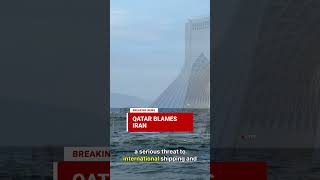
 Reference video
Reference video may not be directly related to the topic of this article
US and Iran Engage in Military Escalation and Maritime Conflict
Military strikes and shipping attacks destabilize global energy.
Event Overview
The U.S. and Iran have entered a cycle of retaliatory strikes, including U.S. attacks on Iranian air defenses and boats and Iranian missile strikes on U.S. bases in Jordan, Bahrain, and Kuwait. Tensions have peaked with attacks on commercial tankers in the Strait of Hormuz, leading President Trump to threaten Iranian infrastructure and announce plans to assert control over the strait. This escalation follows the death of Ayatollah Ali Khamenei on February 28 and the failure of a Memorandum of Understanding between the two nations.
Issue Summary
Bias Distribution
Bias Signal Summary
266 articles — 7 signal types detected.
Coverage Tone Distribution
· AlignedRedder = higher bias. Larger area = more outlets. Click an outlet to jump to its position.
AI Analysis
Missing are the perspectives of the Iranian government and its citizens, as well as the viewpoints of regional allies and neutral nations affected by the instability in the Strait of Hormuz. There is also a lack of analysis regarding the internal power struggle and succession dynamics within Iran following the death of Ayatollah Khamenei.
Related Coverage
Coverage flow
Coverage volume
Focus shift
사건 전개
Recommended Reads
U.S. launches back-to-back waves of strikes against Iran
CBS News
U.S. fires a new wave of strikes on Iran and hits a tanker trying to skirt its blockade - NPR
NPR
Iran reports new attacks on military targets on its largest island near the Strait of Hormuz - AP News
AP News
Trump’s time is running out to avoid a nightmare Strait of Hormuz scenario - Fortune
fortune.com
Analysis of 29 outlets reveals a divide: 12 focused on the volatility of US military and diplomatic maneuvers, 9 advocated for aggressive action and maximum pressure against Iran, and 8 were critical of US hegemony and the instability caused by its foreign policy.
The writer intends to convey that while the U.S. and Israel remain allies, there is significant strategic divergence and personal distrust between their leaderships, leading to a decoupled approach to the Iranian threat.
The writer intends to portray Trump as a decisive, dominant leader who is effectively 'disciplining' a 'sick' and 'crazy' regime through unpredictable and overwhelming force, framing the aggression as a necessary and controlled 'bitch slap' rather than an uncontrolled war.
The writer intends to portray the current U.S. strategy toward Iran as contradictory and volatile, leaving the reader to question whether the administration is employing a calculated negotiation tactic or risking an uncontrolled escalation of war.
The writer intends to convey a sense of urgency and instability, framing the military actions as a 'major escalation' to instill fear or concern in the reader about the possibility of a full-scale war.
The writer intends to convey a sense of strategic instability and pessimism regarding U.S. foreign policy in the Middle East by highlighting a high-profile expert's warning that the current military approach lacks a clear objective or exit strategy.
The writer intends to highlight the fragility of regional diplomacy by contrasting the Qatari government's desperate push for a diplomatic resolution with the aggressive military actions and rhetoric of the U.S. and Iran.
The writer intends to convey that the current 'war-not-war' is a precarious instability that masks a deep divide between resilient wealthy economies and vulnerable poor ones, warning the reader that the current economic stability is an illusion that could collapse for the global south.
The writer intends to portray the Iranian regime as a volatile, 'terrorist' entity whose actions are so disruptive that even its close ally, China, is becoming frustrated and critical. The reader is expected to perceive Iran as the primary aggressor and the U.S. position as a necessary response to 'evil' leadership.
The writer intends to instill a sense of economic anxiety in the reader by linking geopolitical instability directly to the immediate, personal cost of filling up a gas tank.
The writer intends to portray Donald Trump as inconsistent and erratic regarding foreign policy, using Hunter Biden's sarcasm to highlight the perceived absurdity of Trump's claims about the Iran war.
Loading comments...